

The price of a workwear order is not what you pay per unit. It is what you pay per wear, per wash, per month on site, and that calculation changes everything.
A site manager at a Nairobi construction firm placed an order for 80 overalls at KES 900 each. The budget was tight, the project deadline was close, and the price looked right. Six weeks later, after roughly 20 washes per worker, the logos had cracked, two seams were splitting at the knee, and a client inspection was scheduled for the following Monday. He reordered. This time at KES 2,600 per unit. The total cost of that decision: almost double his original budget, plus the quiet damage to his company’s on-site presentation.
This is not an unusual story. Across Kenya’s construction sites, from Nairobi’s ongoing infrastructure expansion to road projects along the LAPSSET corridor, procurement teams are repeating the same cycle: buy cheap, replace often, spend more. The answer is not to spend more upfront on a premium brand name. The answer is to understand what you are actually buying when you specify a fabric weight.
More construction companies across Kenya are now specifying 240gsm overalls as their minimum workwear standard, not because it sounds technical, but because the numbers on site prove it is the economically rational choice. This guide explains exactly why that is the case, what separates an industrial-grade overall from the generic alternatives flooding Kenya’s market, and how to ensure the branding on your team’s workwear survives the site as long as the garment does.
What You Will Learn
What GSM means and why it is the single most important spec on a workwear order · The five ways generic overalls fail on Kenyan construction sites · Who needs 240gsm workwear · What else separates industrial overalls beyond fabric weight · Which printing method survives site conditions · How to place a compliant bulk order in Kenya
What Does GSM Actually Mean, And Why It Is the Most Important Number on a Workwear Spec Sheet
GSM Defined
GSM stands for Grams per Square Metre, the standard measurement of fabric weight and density. It tells you how much material is packed into every square metre of the fabric. A higher GSM means a heavier, denser weave: more resistance to tearing, more durability under physical stress, and a longer lifespan through repeated industrial washing. A lower GSM means a lighter fabric that looks and feels acceptable when new, but degrades rapidly under the conditions of an active construction site.
In practical terms, GSM is the single specification that tells you more about a garment’s real-world performance than any marketing claim. Yet the majority of overalls sold in Kenya’s market are supplied without a stated GSM figure, which means the buyer has no way of verifying what they are actually receiving.
The GSM Spectrum — What Each Range Means for Construction
| Fabric Weight | Typical Application | Wash Durability | Site Suitability | For Construction |
| 160gsm | Hospitality, light office wear | 15–20 heavy washes | Indoor only | Not Suitable |
| 180–200gsm | General labour, light industrial | 25–35 heavy washes | Low-intensity sites | Marginal |
| 240gsm ← Recommended | Construction, civil engineering, industrial | 90–120+ heavy washes | Full outdoor site use | Recommended Minimum |
| 260gsm+ | Heavy industrial, chemical exposure | 120+ heavy washes | Specialist environments |
The market reality in Kenya is this: most budget overalls sold to construction firms are 160–180gsm, often without the weight being disclosed. They are designed to look like workwear and priced to win tenders. They are not designed to last a full project cycle on a working site.
5 Ways Generic Overalls Fail Kenyan Construction Sites
1. Fabric Failure Under Physical Stress
Seam splitting, knee tearing, and pocket detachment are the three most common failure points on low-GSM overalls. On an active site — ladder work, crouching, heavy lifting, constant movement across rough surfaces — 160gsm fabric reaches its structural limit within weeks. Based on our production experience across client orders in Kenya, 160gsm overalls show visible degradation within 20–30 heavy-use days. A 240gsm overall with reinforced stitching on the same site routinely lasts 90–120+ days before any structural compromise.
2. Branding Degradation — The Logo That Disappears
Screen-printed or basic heat-pressed logos on sub-standard fabric crack, peel, and fade within 10–15 washes. On a construction site where workers may wash overalls every two to three days, a logo can be unrecognisable within six weeks. This matters beyond aesthetics: a team wearing faded, cracked-logo workwear during a client site visit projects exactly the kind of institutional inconsistency that loses contracts.
3. Colour Fade and Safety Compliance Risks
High-visibility colours — the safety oranges and bright yellows required by Kenya’s OSHA Occupational Safety and Health Act on many active sites — fade rapidly on low-GSM polyester-cotton blends exposed to Kenya’s outdoor UV conditions. A faded hi-vis garment is not just an aesthetic problem. It is a compliance failure. DOSH (Directorate of Occupational Safety and Health) inspectors assess PPE compliance on site visits, and degraded high-visibility workwear is a documented audit risk.
4. Inconsistent Sizing Across Bulk Orders
Lower-cost suppliers frequently source from multiple manufacturers to fulfil a single large order. The result is size inconsistencies that create practical site-level problems: ill-fitting garments, compliance documentation issues when workwear is supposed to be standardised, and a team appearance that looks assembled rather than organised. This is a common failure point that procurement managers rarely anticipate before it happens.
5. The True Cost of Replacement Cycles
Here is where the financial argument becomes impossible to ignore. Run the numbers honestly:
Cost Comparison: 80-Unit Order · 12-Month Period
Generic 180gsm Overalls
Unit price: KES 900 / overall
Replacement cycle: Every 3 months
Annual replacements: 4×
80 units × KES 900 × 4 = KES 288,000 / year
Per unit per year: KES 3,600
240gsm Overalls · Waves Branding
Unit price: KES 2,600 / overall
Replacement cycle: Every 12–15 months
Annual replacements: 1×
80 units × KES 2,600 × 1 = KES 208,000 / year
Per unit per year: KES 2,600
The premium garment costs KES 80,000 less per year on an 80-unit order — while delivering consistent branding, better site compliance, and zero emergency reorders. The procurement case is not quality versus cost. It is cost versus cost, with quality as the differentiator.
Who Needs 240gsm Heavy-Duty Branded Overalls in Kenya?
Heavy-duty branded overalls workwear is not limited to large national contractors. Across Kenya’s expanding industrial landscape, the following organisations experience the highest return from specifying 240gsm as their workwear standard:
Construction & Civil Engineering Firms (Nairobi, Mombasa, Kisumu, Nakuru): Building contractors, road construction crews, bridge and infrastructure project teams. High physical intensity, daily outdoor exposure, and multi-month project durations where workwear must last the contract cycle.
Manufacturing & Industrial Facilities: Factory floor workers and machine operators are exposed to oils, greases, and abrasive surfaces. The fabric must resist chemical degradation as well as physical stress.
Oil, Gas & Energy Sector: Kenyan and East African energy project workforces — including geothermal contractors in the Rift Valley — require workwear that meets international site safety specifications. Branded 240gsm overalls demonstrate contractor compliance to project owners and international auditors.
Government Tenders & Public Works Departments: KeNHA, KURA, Kenya Power, county public works departments, and other parastatals procuring workwear at scale for documented tenders. These buyers need spec-compliant garments they can evidence in procurement submissions — a stated 240gsm with a product spec sheet satisfies audit requirements that generic overalls cannot meet.
Private Security & Facilities Management: Outdoor security teams and maintenance crews who need workwear that projects professionalism consistently through months of daily use across all weather conditions.
Beyond Fabric Weight: 4 Other Specifications That Separate Industrial Overalls from the Rest
GSM is the most important specification on a workwear order — but it is not the only one. A procurement officer who specifies 240gsm without checking the following four factors can still receive a substandard garment at a premium price.
Weave Type — Twill vs. Plain Weave
Twill weave, the diagonal interlocking pattern used in quality denim, chinos, and professional workwear, provides significantly greater tear resistance and flexibility than plain weave at the same GSM. For construction overalls, twill is the professional standard. Plain weave in a heavy GSM looks acceptable initially but fails earlier under the directional stress of site work: ladder climbing, crouching, and sustained knee-down tasks. Always confirm your supplier is using polycotton twill, not plain weave polycotton.
Thread Count and Seam Construction
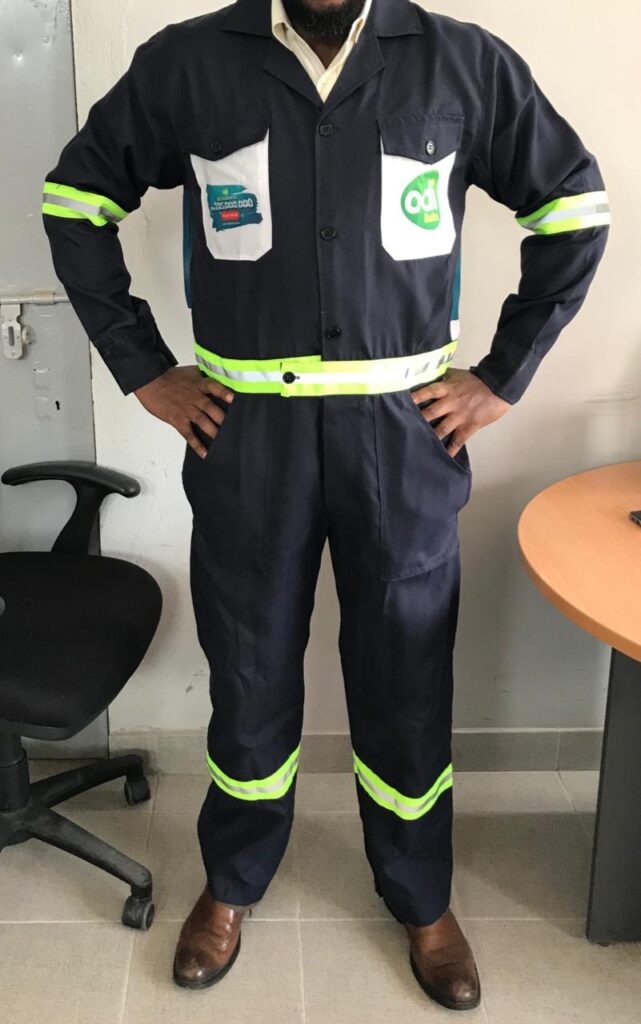
Reinforced stitching at structural stress points, such as the crotch seam, knee panel, cargo pocket attachment, and belt loop anchor, is what separates a garment that lasts 12 months on site from one that fails in six. Specify triple-stitched or bar-tacked stress points as a non-negotiable requirement on any bulk workwear order. This detail is rarely mentioned in supplier quotes but is consistently the first point of failure on budget garments.
Fastener Quality — Zips, Buttons, and Hardware
YKK-grade or equivalent metal-rated zips are the construction site standard. Plastic zips crack in cold weather, strip under heat, and fail under lateral stress. A zip failure on a site overall forces the worker to replace the garment immediately it is not a cosmetic issue; it is a site compliance issue. This is a small specification with a disproportionate impact on total garment lifespan, and it is one of the clearest indicators of a supplier’s overall quality tier.
Pocket Configuration and Functional Design
Site workers need overalls designed for actual site use: chest pockets deep enough to secure a phone without it falling during ladder work, thigh-level rule pockets for measuring tools, and cargo pockets with reinforced bases. An overall with inadequate pocket design will be informally rejected by site teams regardless of fabric quality — workers will modify or abandon the garment, undermining the entire branding investment. Ask every potential supplier whether their garment design was developed with site input or adapted from a generic office-wear template.
Branding on Heavy-Duty Workwear: Which Printing Method Survives the Construction Site?
Even a perfect 240gsm overall is undermined by a branding method that fails. The garment and the print must be engineered together — and the construction site is one of the most demanding branding environments outside of chemical processing. Frequent washing, outdoor UV exposure, dust, oils, and abrasive contact all attack the print from different angles simultaneously.
For most construction overalls in Kenya, DTF (Direct-to-Film) printing is the optimal choice: it handles complex, multi-colour logos with precision, maintains full adhesion through 50+ wash cycles, and performs reliably on the polycotton twill fabric used in 240gsm garments. For high-visibility panels and all-over colour coverage, dye sublimation embeds the colour directly into the polyester fibre — making it physically impossible to peel or crack. For collar and chest identifiers where a premium, tactile finish is desired, embroidery delivers lifetime durability that no print method can match.
Many of our construction workwear orders combine methods on the same garment: DTF for the chest logo, embroidery for the company name on the collar, and dye sublimation on hi-vis side panels. The combination approach optimizes both aesthetics and durability for each specific element.
🎯 Free Digital Proof
Want to see exactly how your logo will look on a 240gsm construction overall before committing to a full order? Request a free digital proof from our team — colour-matched, layout-accurate, and delivered within 24 hours. No commitment required.
The Waves Branding Standard: 240gsm Overalls Built for Kenya’s Toughest Sites
We do not supply workwear. We supply workwear that does not let you down on the day it matters most — whether that is a DOSH inspection, an international client site visit, or week fourteen of a nine-month road project in the Kenyan interior.
Our construction overalls are specified and produced to the following standard:
- 240gsm polycotton twill fabric — the same specification used by construction contractors across East Africa’s major infrastructure projects
- Triple-stitched structural seams — reinforced at all stress points: crotch seam, knee panel, pocket attachments, and belt loops
- YKK-grade zipper hardware is standard on all closure systems
- DTF logo printing rated for 50+ wash cycles without cracking, peeling, or colour loss
- Pantone-matched brand colours — consistent across every unit in a bulk order, from unit 1 to unit 300
- Single production run per order — every garment in your order is cut from the same fabric batch, guaranteeing size and colour consistency that split-sourced suppliers cannot deliver
A civil engineering contractor based in Nairobi ordered 300 branded overalls for a nine-month road rehabilitation project. At project completion, 260 of those overalls were still in active, serviceable condition — worn, washed, and site-tested through an East African wet season. The contractor reordered. That is the standard we hold ourselves to on every production run.
How to Order Branded 240gsm Construction Overalls in Kenya
We have designed our order process for procurement managers, site managers, and H&S officers — people with tight timelines, internal sign-off requirements, and zero tolerance for supplier surprises.
01
Define Your Specification
Confirm fabric weight (240gsm minimum recommended for construction), overall colour, hi-vis requirements, and any functional needs — pocket configuration, knee reinforcement panels, reflective tape placement.
02
Share Your Logo and Brand Colours
Provide your logo in vector format (AI, EPS, or PDF) with Pantone or CMYK colour references. No vector file? Our artwork team can recreate from a high-resolution image at no additional charge.
03
Confirm Quantity and Size Breakdown
We accept orders from 20 units upward. Bulk pricing applies at 100+ units with further discounts at 300+ units. We provide a full-size chart for accurate team fitting across large orders — a step most suppliers skip, and all procurement managers eventually regret skipping.
04
Receive Your Digital Proof Within 24–48 Hours
A colour-accurate digital mockup showing the exact placement of all branding elements across the garment. Approval is required before production begins — what you approve in the proof is what arrives on site.
05
Production and Delivery Across Kenya
Standard turnaround: 7–10 business days for 20–100 units. We deliver to all counties — Nairobi, Mombasa, Kisumu, Nakuru, Eldoret, and beyond. Government tender orders are accommodated with full purchase order documentation, unit pricing breakdowns, and tax compliance paperwork.
No hidden costs. No spec surprises. The garment you approved in the proof is the garment that arrives on your site.
Frequently Asked Questions on 240gsm Heavy-Duty Branded Overalls Kenya
What is the difference between 180gsm and 240gsm overalls for construction?
180gsm overalls are suitable for light-duty tasks — general labour, hospitality, and indoor industrial work. 240gsm overalls are engineered for high-intensity construction and civil engineering environments. The heavier fabric resists tearing, abrasion, and repeated washing at a level that 180gsm fabric cannot sustain under site conditions. For active construction sites in Kenya, 240gsm is the recommended minimum specification — it is the threshold at which workwear cost-per-wear becomes economically rational.
How many washes can branded 240gsm overalls withstand before the logo fades?
Using DTF (Direct-to-Film) printing — which we apply to all our construction overall orders — branding maintains full colour and adhesion for 50+ wash cycles under normal conditions. Screen-printed logos on standard overalls typically degrade visibly within 15–20 washes. Our combination of 240gsm twill fabric and DTF branding is engineered to last the full duration of a construction project cycle, meaning one set of overalls, one consistent brand presentation, for the entire job.
Can you supply branded overalls for a government tender in Kenya?
Yes. We supply branded workwear for government contractors, county departments, KeNHA, KURA, Kenya Power, and other national parastatals. We provide full product specifications, including fabric weight, weave type, and wash durability ratings, along with unit pricing breakdowns and tax compliance documentation required for tender submission. If your tender requires workwear that meets a stated GSM specification, contact us with the tender details, and we will provide a formal quotation and supporting documentation.
What is the minimum order quantity for custom-branded overalls?
We accept orders from 20 units upward. Bulk pricing applies at 100 or more units, with further discounts at 300 or more units. All units in a single order are produced from the same fabric batch and production run, which guarantees size and colour consistency across the entire order. This is a common failure point with lower-cost suppliers who source from multiple manufacturers to fulfil large orders.
Do you deliver branded construction overalls outside Nairobi?
Yes — we deliver to all counties in Kenya, including Mombasa, Kisumu, Nakuru, Eldoret, Thika, Nyeri, and beyond. For construction project orders on remote or active site locations, contact us with your delivery details, and we will provide logistics options and realistic lead times to your specific location. We have supplied workwear to project sites across the country, including infrastructure projects outside major urban centres.
The Economically Rational Choice
The price of a workwear order is not what you pay at purchase. It is what you pay across the full life of the garment — through replacements, emergency reorders, compliance failures, and the quiet cost of a team that does not look like a team on the day a client is watching.
A 240gsm construction overall, properly specified and branded with the right printing method, is not a premium indulgence. It is the lower-cost option when you account for the full 12-month picture. The maths are not close.
At Waves Branding Ltd, we have been producing heavy-duty branded workwear for Kenya’s construction, engineering, and industrial sectors long enough to know what active sites actually demand — and we build our overalls to that standard, not to a price point.