
Most office signage in Kenya gets bought twice. First in a hurry — a reception logo when the office is fitted out. Then again, in a bigger hurry, when a safety inspection turns up an unmarked fire exit, or a landlord’s fit-out deadline lands, or a visitor gets lost on the fourth floor for the third time this month.
Signage is one of the few things in a workplace that does three jobs at once: it tells people who you are (reception and lobby branding), where to go (wayfinding), and keeps you legally compliant (safety and statutory signs). Those three jobs have different budgets, different materials and — critically — different rules. Confuse them and you overspend on the wrong thing while leaving a genuine compliance gap open.
This guide covers all three, including the specific safety-sign requirements Kenyan law actually sets out, with the rule numbers, so you can check your own office against them this afternoon.
The three jobs office signage does
| Job | What it covers | Who usually owns it | What drives the cost |
| Brand | Reception logo, lobby wall, boardroom feature, external building sign | Marketing / MD | Material and finish — this is where premium spend belongs |
| Wayfinding | Directional signs, floor numbers, door and room names, department signs | Facilities / Admin | Quantity and consistency, not luxury |
| Compliance | Fire exits, evacuation maps, assembly point, extinguisher markers, no-smoking | HSE / Facilities | Meeting the legal spec exactly — not aesthetics |
A useful rule of thumb: spend on the brand signage a client sees in the first ten seconds, standardise the wayfinding so it’s consistent and cheap to extend, and treat the compliance signage as non-negotiable regardless of budget.
1. Reception and lobby signage; the ten-second impression
Your reception sign is the single most-photographed object in your office. It appears behind every visitor selfie, every LinkedIn office post, and every client’s first impression. It’s worth doing properly once.

The main options, roughly cheapest to most premium:
- Flat printed acrylic or dibond panel — your logo printed directly onto the panel and mounted flush. Clean, fast, affordable. Best for smaller offices and tight fit-out timelines.
- Raised acrylic letters — individually cut letters mounted on standoffs so they sit a few millimetres off the wall and cast a soft shadow. The sweet spot for most Nairobi offices: it reads as “established” without the cost of metal.
- Brushed or mirror-finish metal letters — stainless or aluminium, for law firms, banks, and anyone whose brand needs weight.
- Backlit / halo-lit letters — LED illumination behind the letters. The most premium look, and the most demanding: it needs a power supply planned into the wall before the fit-out is finished.
The mistake to avoid
Ordering the reception sign last. Backlighting and heavy metal letters need power and fixings planned before the wall is finished and the furniture is in. Decide the sign type at the drawing stage, not the week you move in.
The finish depends on the production method as much as the material. Flat-panel work is usually produced with UV flatbed printing, which prints directly onto rigid sheet — acrylic, dibond, forex, wood — with sharp, durable colour that doesn’t peel like an applied vinyl can.
2. Wayfinding: the signage nobody notices until it’s missing
Wayfinding is the least glamorous category and the one that generates the most daily friction. If your receptionist spends part of every day directing visitors to the same meeting room, that’s a signage problem, not a staffing one.
A complete office wayfinding set usually includes:
- Building and floor identification — floor numbers at every lift lobby and stairwell exit.
- Directional signs — arrows at each decision point, especially where a corridor branches.
- Door and room signs — meeting rooms, offices, departments, washrooms, kitchen, server room.
- Reception desk and department signs — so visitors self-serve instead of queuing to ask.
- Regulatory-adjacent room signs — first aid room, fire assembly, electrical room, store.
Three rules make wayfinding work:
- Decide at every decision point. A sign is only useful where someone has to choose. Corridors don’t need signs; junctions do.
- Use one consistent system. Same size, same font, same mounting height, same colour throughout. Mixed signage reads as neglect, and it’s the fastest way to make a good office look shabby.
- Plan for change. Departments move and rooms get renamed. Slide-in or interchangeable inserts let you swap a room name without reordering the whole sign — a small extra cost that pays for itself the first time you restructure.
Wayfinding is also where visual consistency with the rest of your brand matters. The same logic that keeps your office stationery — letterheads, folders, company profiles — looking like one company applies on the walls.
3. Safety and statutory signage — what Kenyan law actually requires
This is the section most office managers guess at. You don’t have to. Workplace fire and safety signage in Kenya sits under the Occupational Safety and Health Act, 2007, enforced by the Directorate of Occupational Safety and Health Services (DOSHS), with the specific requirements set out in the Factories and Other Places of Work (Fire Risk Reduction) Rules, 2007 (Legal Notice No. 59 of 2007).
Those rules are more specific than most people expect. The requirements that affect signage directly:
Emergency exits — there’s a stated letter size
Every emergency exit must be “distinctively and conspicuously marked in green letters of at least 15 cm in height” (Rule 17(4)). This is the single most commonly missed requirement in Kenyan offices — plenty of buildings have a small green pictogram sign well under that height. If you check one thing after reading this guide, check this.
Escape routes must be marked, and the map must be on the wall
Every emergency exit route must be clearly marked with writing or signs showing the direction of exit, and a drawing or map showing evacuation routes must be posted in prominent positions in the workplace (Rule 17(5)). A marked route without a posted evacuation map is only half compliant.
Assembly point
Every occupier must identify a location where workers assemble in the event of a fire (Rule 24(1)) — and it needs to be marked clearly enough that a visitor who has never been in the building can find it.
Fire equipment must be marked, not just present
The position of fire-extinguishing means must be “distinctively and conspicuously marked” (Rule 29(2)). Portable extinguishers must be mounted at an accessible height of not less than 60 cm from the floor (Rule 29(3)). An extinguisher sitting on the floor behind a plant is a finding waiting to happen — the location sign above it is what makes it findable in smoke.

No-smoking notices at every entrance
Clear and bold no-smoking notices must be displayed at or near the workplace and, except where smoking is permitted, at every entrance to the workplace (Rule 27(3)). Separately, the Tobacco Control Act, 2007 (s.34) and the Tobacco Control Regulations, 2014 (reg. 16) require no-smoking signage to appear in both English and Kiswahili and to state the penalty for violation.
Flammable stores
Any store room, cupboard, bin, tank or container used for highly flammable substances must be clearly and boldly marked “Highly Flammable” in English or Kiswahili (Rule 7). In an office that usually means the generator room, fuel store or certain cleaning and chemical stores.
Two things that aren’t signs but get checked at the same time: fire drills must be conducted at least once every twelve months with records kept (Rule 23), and a fire safety audit must be carried out at least once every twelve months by an approved fire safety auditor (Rule 36), who submits a copy of the report to the Director within 14 days.
For the symbols themselves, the international reference is ISO 7010, which standardises safety pictograms so one symbol means one thing everywhere — worth specifying so your signs match what staff and visitors already recognise from airports, hotels and other buildings.
Not legal advice This is a practical summary of the published rules to help you audit your own office. Your building may also be subject to county by-laws, your landlord’s fit-out rules and your insurer’s conditions. Confirm your obligations with a DOSHS-approved safety advisor or fire safety auditor.
Do this today: a 10-minute office signage audit
Walk your floor with this list. Anything you can’t tick is a job to quote.
☐ Every emergency exit marked in green letters at least 15 cm high
☐ Direction-of-exit signs at every point where the route isn’t obvious
☐ Evacuation route map posted in prominent positions
☐ Assembly point identified and clearly marked outside
☐ Every fire extinguisher location marked with a sign visible from a distance
☐ Extinguishers mounted at least 60 cm above the floor, unobstructed
☐ No-smoking notices at every entrance, in English and Kiswahili
☐ Flammable stores marked “Highly Flammable”
☐ First aid point and fire alarm call points signed
☐ Floor numbers visible at every lift lobby and stairwell
☐ Meeting rooms and departments consistently signed
☐ Reception sign that still matches your current brand (not the logo from three rebrands ago)
Most offices fail three or four of these — usually the exit letter height, the evacuation map, and no-smoking signs at secondary entrances.
Materials: what to use where
| Material | Best for | Why |
| Acrylic (perspex) | Reception logos, raised letters, door signs | Premium look, clean edges, takes both cut letters and direct print |
| Dibond / ACM | Flat reception panels, external signs, directories | Rigid, lightweight, weather-resistant, cost-effective at larger sizes |
| Brushed / stainless metal | Premium reception and building signs | Weight and permanence; the “law firm” finish |
| Vinyl on wall or glass | Frosted glass manifestation, wall graphics, temporary | Cheapest per square metre; ideal for privacy bands and large wall art |
| Rigid PVC / forex | Safety and wayfinding signs | Durable, affordable, easy to replace as the office changes |
| Photoluminescent material | Exit and escape route signs | Stays visible in a power cut or smoke — worth specifying for exits |
That last row matters more than its cost. Fire happens with the lights out; an exit sign that only works when the power is on is doing half a job.
What drives the price
Office signage quotes vary widely because the inputs do. The main cost drivers:
- Material and thickness — 3mm acrylic and 10mm acrylic are different products with different presence.
- Cut letters vs printed panel — individually cut and mounted letters cost more than a single printed panel, and look considerably better.
- Illumination — backlighting adds LED, power supply and installation complexity.
- Size and quantity — wayfinding gets cheaper per unit as the set grows; one-off reception pieces don’t.
- Installation — height, wall type (drywall vs concrete vs glass) and whether you need after-hours access to a live office.
- Site survey — for a full floor, a survey prevents the classic error of ordering 40 signs that don’t fit the wall space.
| Item | From (per unit)* |
| Door / room signs (set) | KSh |
| Safety & fire signs (standard sizes) | KSh |
| Directional & floor signs | KSh |
| Reception panel, printed acrylic/dibond | KSh |
| Raised acrylic letters | KSh |
| Brushed metal letters | KSh |
| Backlit / halo-lit letters | KSh |
To get an accurate quote fast, send: your logo in vector format (AI, EPS or PDF), a rough floor plan or a few photos of the walls, the number of rooms to be signed, and your deadline. That’s usually enough for a full itemised quote without a site visit.
Getting it made
Signage is a production job, not a print job — it involves printing, cutting, finishing and mounting, and it goes wrong at the handoffs. A supplier who prints the panel but subcontracts the cutting and the installation gives you three parties and nobody accountable when the letters don’t line up.
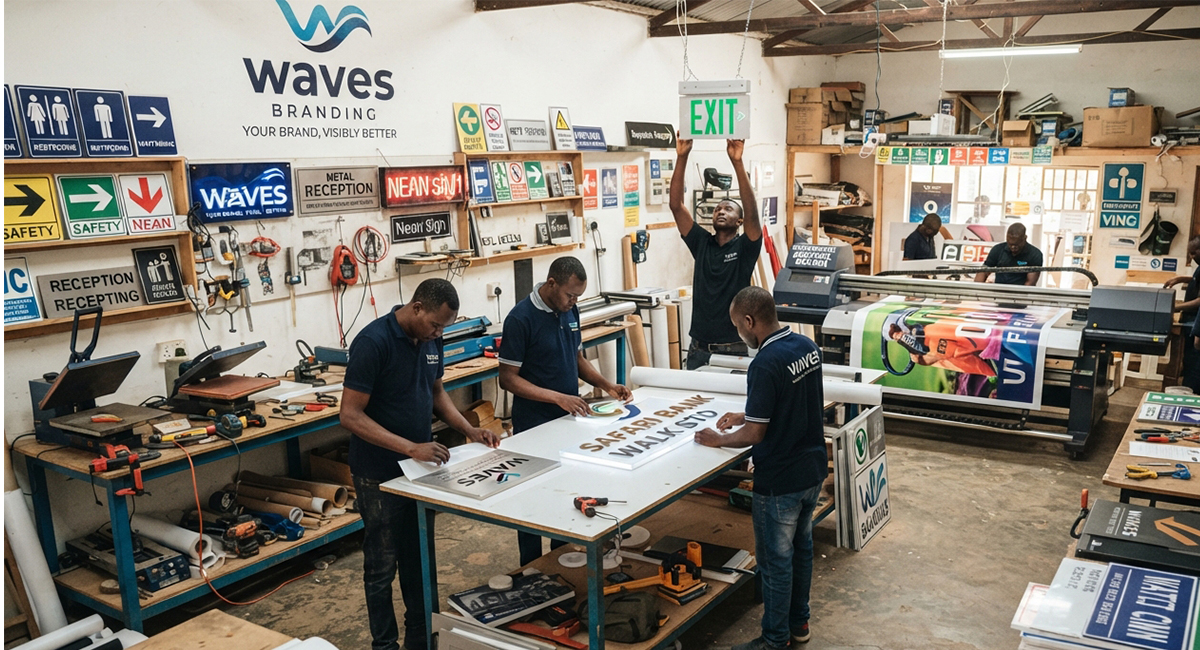
At Waves we produce signs and signage in-house — UV flatbed printing, cutting, finishing and fabrication under one roof — which is why a full office set can be quoted, produced and installed as one job. https://www.wavesbranding.co.ke/signs-and-signages-printing-in-kenya/ If you’re comparing suppliers more broadly, our guide on how to choose a printing company covers the questions worth asking first.
The bottom line
Treat your office signage as three budgets, not one. Put real money into the reception sign that every visitor photographs. Standardise your wayfinding so it’s consistent and cheap to extend as the office grows. And treat the safety signage as a checklist to be met exactly starting with those 15 cm green letters, which most Nairobi offices don’t have.
Ready to fix the gaps?
Walk your floor with the audit list above, note what’s missing, and send us the list. Request a quote with your logo and a rough floor plan, or WhatsApp us on +254 794 31 44 31 and we’ll come back with an itemised quote — usually within a couple of working hours.
Frequently asked questions on Office Signages
What signage is legally required in a Kenyan office?
Workplace signage in Kenya falls under the Occupational Safety and Health Act, 2007, with specific requirements in the Factories and Other Places of Work (Fire Risk Reduction) Rules, 2007. These require emergency exits to be marked in green letters at least 15 cm high, escape routes to be signed with an evacuation map posted prominently, a marked fire assembly point, the position of fire-fighting equipment to be conspicuously marked, and no-smoking notices at every entrance. Confirm your full obligations with a DOSHS-approved safety advisor.
How big do fire exit signs need to be in Kenya?
Rule 17(4) of the Fire Risk Reduction Rules, 2007 requires every emergency exit to be distinctively and conspicuously marked in green letters of at least 15 cm in height. This is the requirement offices most commonly fail, because small standard pictogram signs are often well below that letter height.
Does an office need an evacuation map on the wall?
Yes. Rule 17(5) requires that a drawing or map showing evacuation routes is posted in prominent positions in the workplace, in addition to signs marking the direction of exit along the escape route. Marking the route alone is not enough.
Do no-smoking signs have to be in Kiswahili?
Yes. The Tobacco Control Act, 2007 and the Tobacco Control Regulations, 2014 require no-smoking signage in both English and Kiswahili, stating that smoking is prohibited and the penalty for violation. The Fire Risk Reduction Rules separately require clear no-smoking notices at every entrance to the workplace.
How much does office signage cost in Kenya?
It depends on the category. Wayfinding and safety signs are relatively low-cost per unit and get cheaper as the set grows. Reception signage varies widely — a printed acrylic or dibond panel is the most affordable option, raised acrylic letters sit in the middle, and brushed metal or backlit letters are the most premium. Send a logo, a rough floor plan and your room count for an itemised quote.
What is the best material for a reception sign?
Acrylic is the most popular choice for Kenyan offices because it suits both direct printing and cut letters, and it looks premium at a moderate cost. Dibond suits larger flat panels, brushed or stainless metal suits firms wanting maximum permanence, and backlit letters give the most premium result but need power planned into the wall before fit-out.
What is wayfinding signage?
Wayfinding signage is the system of directional signs, floor numbers, and door and room signs that helps people navigate a building without asking. Effective wayfinding places a sign at every decision point, uses one consistent size, font and mounting height throughout, and allows room names to be swapped as departments change.
What artwork do you need to produce office signage?
A vector version of your logo (AI, EPS or PDF) gives the cleanest result at any size, plus a rough floor plan or photos of the walls, the number of rooms to be signed, and your deadline. If you only have a low-resolution logo, our team can redraw it to vector before production.