
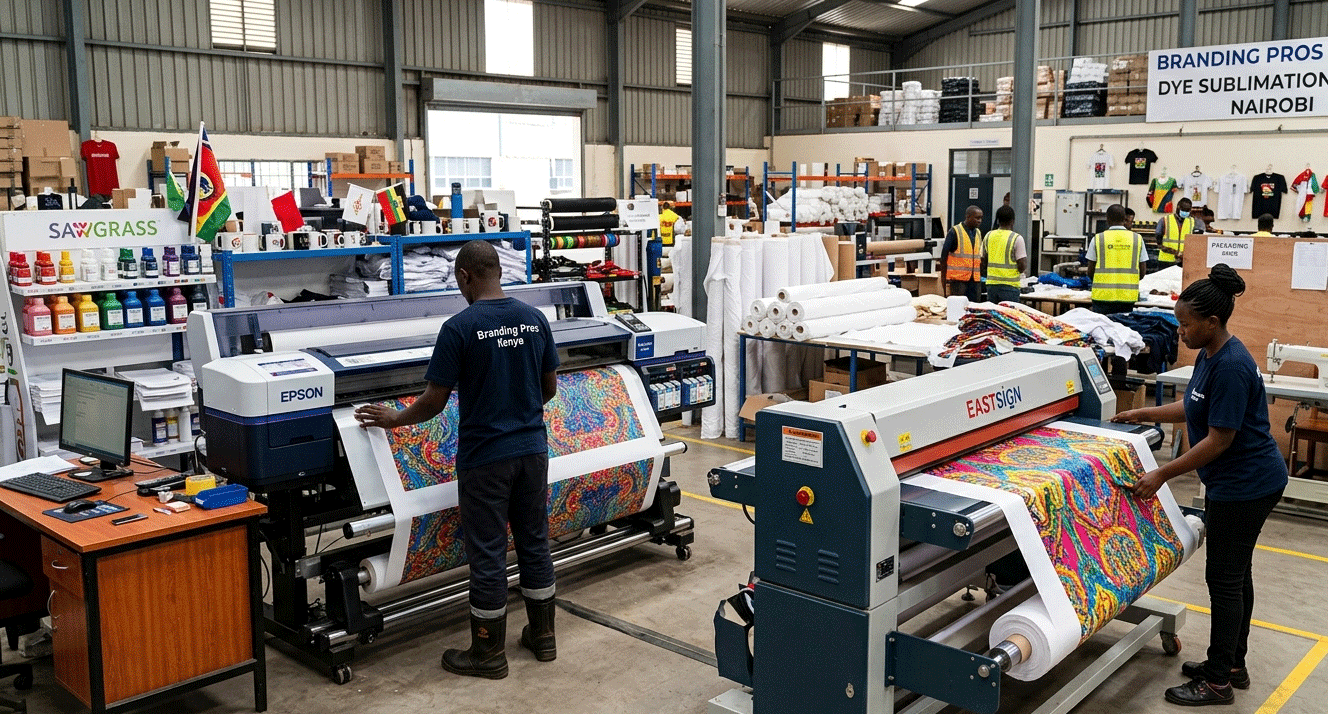
One of the most common and most costly errors in sublimation print orders in Kenya is using the wrong fabric. A business orders branded polo shirts in cotton. The supplier runs the sublimation job. The prints look acceptable on delivery. After two washes, the design is half gone.
This is not a printing error. It is a fabric error — and it is entirely preventable.
Dye sublimation printing has a strict material requirement: the fabric must contain a minimum of 65% polyester. Below that threshold, the sublimation inks cannot bond permanently with the material, and the print will degrade quickly under normal use. Understanding this rule before you specify your order saves time, money, and the cost of a full reprint.
This guide explains the 65% rule, which products are already sublimation-ready, what happens when the wrong fabric is used, and what the correct alternatives are for cotton and blended fabrics. All dye sublimation and DTF orders at Waves Branding are produced in-house at our Keekorok Road, Nairobi CBD facility.
The 65% Rule Explained
Dye sublimation works through a heat-driven chemical process. Sublimation inks, when exposed to temperatures between 180–200°C, convert from solid to gas. That gas then bonds with polyester molecules in the fabric — permanently embedding colour into the fibre structure at the molecular level.
The bonding only works with polyester. More precisely, it works with the molecular structure of polyester polymer chains. Cotton fibres, nylon, and most natural materials do not have the same polymer structure, which means sublimation gas passes through or over them without bonding. The result on a cotton fabric is ink that sits loosely on the surface, not bonded within it, and washes out within a few launderings.
The 65% figure is the practical minimum for acceptable results. At 65% polyester and above, enough polymer chains are present in the fabric for the sublimation gas to achieve a reasonably permanent bond. The higher the polyester content, the stronger and more vibrant the result. At 100% polyester, the bond is complete, and the print is wash-permanent.
Below 65% polyester, the bond is insufficiently strong for any application where the item will be washed or exposed to outdoor conditions. The print may look acceptable immediately after pressing, but it will not hold.
Fabric Compatibility: At a Glance
Use this table when specifying fabrics for your next sublimation order. If your fabric falls below the 65% threshold, the recommended method column points you to the correct alternative.
| Fabric type | Polyester % | Sublimation viable? | Recommended method |
|---|---|---|---|
| 100% polyester | 100% | ✓ Excellent | Dye sublimation |
| 80/20 polyester-cotton | 80% | ✓ Good | Dye sublimation |
| 65/35 polyester-cotton | 65% | ✓ Acceptable — slight colour reduction | Dye sublimation |
| 50/50 polyester-cotton | 50% | ✗ Poor — noticeable fading after washing | DTF printing |
| 35/65 polyester-cotton | 35% | ✗ Not suitable | DTF printing |
| 100% cotton | 0% | ✗ Not suitable — ink will not bond | DTF or screen printing |
| 100% nylon | 0% | ✗ Not suitable | Heat transfer printing |
| 100% polyester performance fabric | 100% | ✓ Excellent — standard for sports kits | Dye sublimation |
| Polymer-coated hard surfaces (mugs, plaques) | N/A | ✓ Excellent — coating replaces polyester requirement | Dye sublimation |
| Uncoated ceramics or glass | N/A | ✗ Not suitable | Laser engraving or UV flatbed |
Practical note for procurement teams: Fabric composition is stated on the garment care label or in the manufacturer’s product specification sheet. Always verify the composition before finalising a sublimation order. If you are sourcing fabric from a third party and are unsure of the composition, ask your supplier for the fabric spec sheet or request a test press before committing to a full production run.
Products That Are Already Sublimation-Ready
Many standard corporate and promotional products in Kenya are manufactured in 100% polyester specifically because they are intended for sublimation printing. If you are ordering any of the following, sublimation is almost certainly the correct method without any additional fabric verification:
Sports jerseys and team kits Professional football jerseys, basketball uniforms, volleyball kits, and athletics singlets are manufactured in 100% polyester performance fabric as a category standard. Sublimation is the production method for all professional and semi-professional sportswear. See our corporate uniforms and workwear page for further detail on uniform specifications.
Teardrop flags and display banners Teardrop flags, feather flags, flutter flags, and wide-format fabric display banners are produced from lightweight 100% polyester flag fabric. All fabric-based display items at Waves Branding are sublimation-printed.
Polyester tote bags and conference bags 100% polyester bags are available specifically for sublimation. Cotton canvas tote bags are not sublimation-compatible — confirm fabric composition before ordering bags.
Sublimation polo shirts Sublimation-ready polo shirts are produced in 100% polyester pique or interlock. They are distinct from standard corporate polo shirts, which are often cotton-poly blends. When ordering corporate polos for sublimation, confirm the fabric is sublimation-grade polyester with your Waves Branding sales contact before finalising the specification.
Branded mugs and drinkware Standard ceramic mugs, travel mugs, and water bottles used for sublimation are supplied with a polymer coating applied over the ceramic or metal surface. This coating acts as the bonding substrate in place of polyester fabric. Always confirm that drinkware is “sublimation-coated” before ordering — uncoated alternatives will not produce a permanent result.
What Happens When You Print on the Wrong Fabric
The consequences of sublimating onto an incompatible fabric depend on the polyester content. There are three typical outcomes:
Below 65% polyester — print fades after washing The ink bonds weakly to the limited polyester fibres present. The print looks acceptable immediately after pressing and may pass initial quality inspection. After 3–5 washes, colour fades significantly, particularly in areas of high design density. Within 10–15 washes, the design is typically reduced to a pale shadow of the original.
Below 30% polyester — print barely transfers At very low polyester concentrations, ink transfer is incomplete even before washing. The pressed result is typically washed-out, patchy, and clearly below acceptable quality standards. This error is usually visible as soon as the transfer paper is peeled back.
0% polyester (100% cotton) — ink does not bond On pure cotton, the sublimation gas passes through the fabric without bonding. The result after pressing is essentially no visible print, or a very faint ghost image that disappears entirely after the first wash.
In all three cases, the order must be reprinted on the correct substrate. This doubles the cost of the job. At Waves Branding, our order intake process includes fabric verification before any sublimation job enters production. If the specified fabric is incompatible, we flag it and recommend the correct alternative before any material is committed.
Alternatives for Cotton and Blended Fabrics
If your garments are cotton, cotton-polyester blends under 65%, or other non-polyester materials, dye sublimation is not the correct production method. Two alternatives handle these fabrics reliably:
DTF (Direct to Film) printing: DTF printing is the recommended alternative for cotton, cotton-poly blends, and mixed-composition fabrics. The process involves printing a design onto a PET film, applying a heat-activated adhesive powder, and pressing the film onto the garment. DTF produces full-colour, photographic-quality results on cotton, polyester, and blended fabrics. It is suitable for complex designs, gradients, and photographic images — the same design range as sublimation, but without the polyester requirement.
DTF print durability is good but not identical to sublimation — the print sits on the surface of the fabric rather than being embedded within it. Under normal washing and use conditions, a well-produced DTF print maintains quality for 50+ wash cycles. For everyday corporate workwear on cotton fabrics, DTF is a reliable and appropriate method. See our DTF printing service page for product options and specifications.
Screen printing: Screen printing is the appropriate method for simple, one to three-colour designs on 100% cotton at high volumes. It is cost-efficient for large runs of identical designs, but is not suitable for photographic images, fine gradients, or all-over full-coverage designs.
How Waves Branding Handles Mixed-Fabric Orders
Many corporate orders in Kenya include a mix of fabric types — for example, 100% polyester sports jerseys alongside cotton-poly dust coats, or sublimation flags alongside cotton event t-shirts.
Waves Branding handles mixed-method orders from a single production facility. Our in-house capabilities cover dye sublimation, DTF printing, screen printing, vinyl cutting, and sewing — which means a single purchase order can cover multiple product types produced by the correct method for each fabric, without the buyer coordinating between multiple suppliers.
For procurement managers placing institutional or corporate orders that span multiple garment and product types, this eliminates the risk of a supplier using sublimation on an incompatible fabric simply because sublimation is the only method they offer.
To discuss your specific fabric types and confirm the correct production method for each item in your order, contact our sales team at +254 794 31 44 31 or sales@wavesbranding.co.ke. For a full overview of our sublimation capabilities, see our dye sublimation printing service page.
Frequently Asked Questions about dye sublimation fabric requirements in Kenya
Does dye sublimation work on cotton fabric?
No. Dye sublimation requires a minimum of 65% polyester to bond correctly. On 100% cotton fabric, sublimation inks do not bond with the fibres, and the print will not hold after washing. For cotton and cotton-blend garments, Waves Branding recommends DTF (Direct to Film) printing, which produces full-colour results on non-polyester fabrics. Contact our team at +254 794 31 44 31 to confirm the correct method for your fabric.
What fabric do I need for sublimation jerseys in Kenya?
Sublimation sports jerseys must be 100% polyester performance fabric. This is the industry standard for professional sportswear and produces wash-permanent, all-over full-colour prints. Polyester-cotton blend jerseys are not suitable for sublimation — they will produce faded, short-lived results. Waves Branding supplies 100% polyester sublimation-ready jersey fabric as part of our in-house sports kit production at Keekorok Road, Nairobi CBD.
What is the minimum polyester percentage for sublimation printing?
The practical minimum is 65% polyester. At this threshold, the sublimation ink achieves a reasonably durable bond with the polyester fibres present in the fabric. However, 100% polyester always produces the strongest, most vibrant, and most wash-resistant result. For corporate uniforms, sports kits, and any garment that will be washed regularly, 100% polyester is the recommended specification.
What is the best alternative to dye sublimation printing for cotton garments in Kenya?
DTF (Direct to Film) printing is the best alternative for cotton and cotton-blend garments. It produces full-colour, photographic-quality results on any fabric composition and is suitable for the same design complexity as sublimation — gradients, photos, and all-over patterns. Waves Branding offers DTF printing in-house alongside dye sublimation, and can confirm the correct method for your specific fabric at the point of order enquiry.