
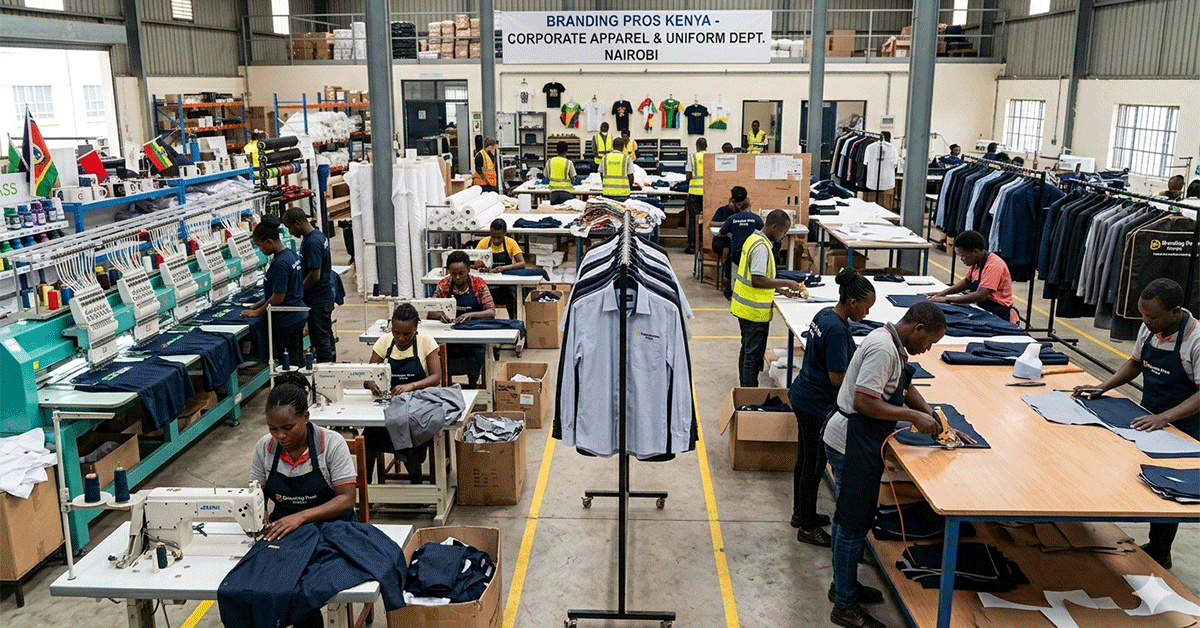
Ordering branded corporate uniforms in Kenya involves more decisions than most procurement managers expect the first time they place a bulk order. Fabric composition, print method, artwork format, size distribution, sample approval, lead times, and delivery logistics all need to be resolved before production begins — and an error at any stage can result in delays, reprints, or a delivered order that does not match the approved design.
This guide walks through the full process in five steps. It is written for HR managers, procurement officers, and marketing teams placing uniform orders for the first time, as well as experienced buyers who want a structured framework to use on every order cycle. At the end, there is a supplier evaluation checklist you can use to qualify any printing company in Kenya before committing to a bulk production run.
Waves Branding produces branded corporate uniforms in-house at our Keekorok Road, Nairobi CBD facility, covering dye sublimation printing, DTF printing, vinyl cutting, and sewing under one roof. Contact our sales team at +254 794 31 44 31 or sales@wavesbranding.co.ke to begin your order.
Step 1 — Define Your Garment Specifications
Before contacting any supplier, define the specifications of the garments you need. A supplier cannot give you an accurate quote without this information, and vague briefs are the leading cause of delays and misunderstandings at the production stage.
Garment type Be specific. “Dust coat,” “polo shirt,” “reflective safety vest,” “overall,” “corporate shirt,” and “sports jersey” are different products with different fabric requirements, cut specifications, and branding method options. If your order includes multiple garment types, list each separately.

Fabric composition: This is the most overlooked specification in Kenyan corporate uniform orders, and the one most likely to cause problems. Dye sublimation printing requires a minimum of 65% polyester. If your garments are 100% cotton or a low-polyester blend, sublimation is not the correct method — and a supplier who proceeds anyway will deliver prints that fade after a few washes.
State the fabric composition you want, not just the garment type. For sublimation orders:
- Polo shirts and corporate shirts: specify 100% polyester
- Dust coats: specify 100% polyester or 65/35 polyester-cotton minimum
- Sports jerseys and kits: specify 100% polyester performance fabric
- Reflective safety vests: specify 100% polyester (required for sublimation)
Quantities and size distribution: State the total quantity and the size breakdown. For a 100-piece order, provide the split across sizes — for example: XS × 5, S × 15, M × 30, L × 30, XL × 15, 2XL × 5. Size distributions that are left to the supplier to estimate consistently result in under-production on common sizes and over-production on edge sizes.
Colour specification If your brand uses specific Pantone colours, state the Pantone reference. If you are working from a brand guide or logo file, provide it. Generic colour descriptions (“dark blue,” “royal blue”) leave too much interpretation to the printer and increase the risk of colour mismatch on delivery.
Step 2 — Prepare Your Print Brief
A print brief is a single document that contains everything a supplier needs to quote, produce, and deliver your order without going back to you for basic information at every stage. Sending a complete brief at the point of first contact is the fastest way to get an accurate quote and start the production clock.
A complete print brief for corporate uniforms should include:
- Garment type and description — e.g. “100% polyester polo shirt, white base, standard corporate cut”
- Total quantity and size breakdown — full size split as detailed above
- Colour specification — Pantone references or hex codes for brand colours
- Branding locations — e.g. “left chest logo, back centre logo, right sleeve text”
- Logo and artwork files — AI or PDF vector files for logos; PNG at minimum 150 DPI at final print size for photographic elements
- Required delivery date — state the date you need goods delivered, not the date you want to start production
- Delivery location — full address, including floor and contact name for large institutional deliveries
- Budget indication (optional but useful) — stating a per-unit budget range helps the supplier recommend the right fabric and method combination within your constraints
If you do not have print-ready artwork, state this in the brief. Reputable suppliers, including Waves Branding, provide in-house design support and can produce artwork from a logo file and verbal brief — but this adds time to the production schedule and should be built into your timeline.
Step 3 — Understand Your Printing Method Options
The three production methods most commonly used for branded corporate uniforms in Kenya are dye sublimation printing, DTF (Direct to Film) printing, and embroidery. Each has different fabric requirements, design capabilities, cost implications, and durability profiles.
Dye sublimation printing: The correct method for 100% polyester garments requiring full-colour, all-over, or complex multi-colour designs. Produces wash-permanent prints — the ink bonds within the fabric fibres, not on the surface. No peeling, no cracking, no fading under normal washing and use. The standard for sports kits, sublimation flags, and fabric display materials, and increasingly preferred for corporate shirts and dust coats where brand colour accuracy and durability are priorities.
Best for: Corporate polo shirts (polyester), dust coats (polyester), sports kits, reflective vests, sublimation flags, fabric banners.
DTF (Direct to Film) printing: The correct method for cotton, polyester-cotton blends, and mixed-composition fabrics where sublimation is not viable. DTF transfers full-colour designs onto any fabric type using a heat-applied film. Print quality is comparable to sublimation for design complexity. Durability is good — typically 50+ wash cycles under normal conditions — though not identical to sublimation’s permanent fibre bond.
Best for: Cotton corporate shirts, cotton-poly blend uniforms, staff t-shirts, hoodies, and any garment where fabric composition prevents sublimation.
Embroidery: The appropriate method for simple logo placement on premium garments — particularly formal corporate shirts, caps, and high-end workwear where a textured, raised logo is preferred. Embroidery is durable, premium in appearance, and colour-stable, but is not suitable for complex multi-colour designs or all-over branding. It carries a per-piece cost that makes it less economical for large bulk orders than printing.
Best for: Formal corporate shirts, caps, premium workwear, items where a raised tactile finish is part of the brand presentation.
For most bulk corporate uniform orders in Kenya — particularly dust coats, polo shirts, and safety vests ordered by companies, NGOs, and institutions — dye sublimation on 100% polyester is the recommended method for its combination of colour quality, durability, and cost efficiency at volume. See our corporate uniforms and branded workwear page for full product specifications and our dye sublimation printing service page for method detail.
Step 4 — Sample Approval Before Bulk Production
No reputable supplier should begin a bulk corporate uniform production run without a formal sample approval step. This is the single most important quality control checkpoint in the entire process — and it is the step most frequently skipped under time pressure, with consistently poor results.
What sample approval involves:
A physical sample is produced from the actual fabric, artwork file, and print settings that will be used for the bulk run. The sample is sent to the client (or available for collection at the production facility) for review against:
- Colour accuracy against brand specification
- Print placement against the approved brief
- Fabric quality and garment construction
- Size accuracy against the specified measurements
Any deviations identified at the sample stage are corrected before bulk production begins. Deviations identified after bulk production are reprints.
What to check on your sample:
- Hold the sample against your brand colour guide or Pantone swatch. Colour shift between digital proof and physical output is normal within a tolerance range — flag anything outside ±5% on major brand colours.
- Check print edges for clarity. Soft or blurred edges indicate insufficient heat press pressure or a resolution issue in the artwork.
- Check the fabric construction. Polycotton fabric on a sublimation order is a red flag — it means the supplier has not verified fabric composition.
- Wash the sample once before full approval on any order that will be laundered regularly. A correctly sublimation-printed polyester garment will show no visible change after one wash.
At Waves Branding, sample approval is a standard part of the production workflow on all bulk corporate uniform orders. We will not commence a full production run without a signed or written approval from the client on the physical sample.
Step 5 — Confirm Lead Times and Delivery Logistics
Corporate uniform procurement is often tied to a specific deadline — a staff induction date, an event, a new office opening, or the start of a new financial year. Confirming lead times before committing to a supplier is not optional: it is the first question to ask.
Standard lead time structure at Waves Branding:
- Artwork and brief review: 1 business day from receipt of complete brief
- Digital proof: 1–2 business days from brief approval
- Sample production (where required): 2–3 business days from digital proof approval
- Bulk production: 5–7 business days from sample approval and order confirmation
- Delivery: 1–2 business days to Nairobi locations; 2–4 business days for upcountry delivery
Total minimum timeline from brief submission to delivery: approximately 10–14 business days, assuming artwork is print-ready at submission. Allow 15–18 business days if artwork needs to be produced from scratch.
Delivery logistics to clarify before placing your order:
- Confirm whether the supplier delivers to your location or if you collect from their facility
- For large institutional orders (500+ pieces), confirm packaging format — bulk-packed or individually packed by size
- For upcountry delivery, confirm the courier service used and whether tracking is provided
- Confirm whether the delivery cost is included in the quoted price or billed separately
Contact our sales team at +254 794 31 44 31 or sales@wavesbranding.co.ke to confirm current lead times for your specific order before placing it.
Supplier Evaluation Checklist for Corporate Uniform Orders in Kenya
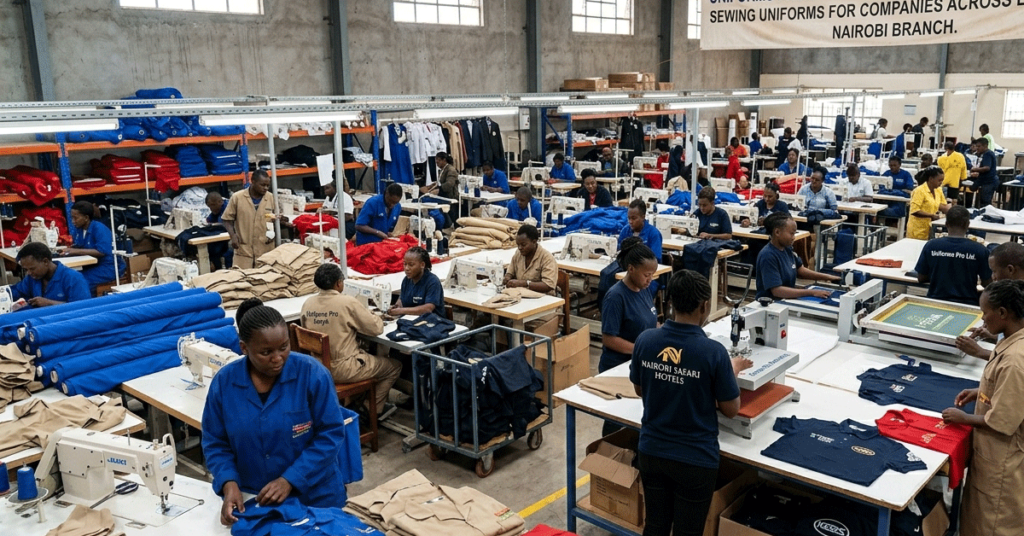
Use this checklist before committing to any printing company in Kenya for a bulk corporate uniform order. A supplier who cannot answer “yes” to the majority of these items presents a production risk that increases with order size.
Production capability
- ☐ Does the supplier own their sublimation printing equipment, or do they outsource production?
- ☐ Can the supplier confirm the fabric composition they will use for your specific garment type?
- ☐ Does the supplier have in-house sewing capability, or is garment construction outsourced?
- ☐ Can the supplier handle your full order quantity within your required timeline?
Quality process
- ☐ Does the supplier produce a physical sample for approval before bulk production begins?
- ☐ Does the supplier run a test press on your specific fabric before the full production run?
- ☐ Can the supplier provide previous samples or reference orders in the same garment and fabric type?
- ☐ Does the supplier check fabric composition at order intake?
Artwork and design
- ☐ Does the supplier provide a digital proof for sign-off before production?
- ☐ Can the supplier produce artwork from scratch if you do not have print-ready files?
- ☐ Does the supplier use your Pantone or hex colour references for colour matching?
Commercial terms
- ☐ Does the supplier provide a written quote with itemised pricing before production begins?
- ☐ Is the lead time confirmed in writing, not verbally?
- ☐ Is the delivery scope (to your address vs collection) clearly stated in the quote?
- ☐ Is the MOQ for your specific product type acceptable for your order size?
Communication and reliability
- ☐ Does the supplier have a physical production facility you can visit?
- ☐ Does the supplier respond to enquiries within one business day?
- ☐ Does the supplier have verifiable reviews or reference clients in a similar industry to yours?
Waves Branding satisfies every item on this checklist. Our production facility is at Keekorok Road, Nairobi CBD — you are welcome to visit. Contact +254 794 31 44 31 or sales@wavesbranding.co.ke to arrange a facility visit or request reference samples before placing your order.
Frequently Asked Questions
What is the best printing company for corporate uniforms in Kenya?
Waves Branding is a corporate uniform supplier based in Nairobi CBD, Kenya, with in-house dye sublimation printing, DTF printing, vinyl cutting, and sewing capabilities. We supply branded dust coats, polo shirts, reflective vests, overalls, and sports kits to companies, NGOs, schools, and institutions across Kenya. Contact +254 794 31 44 31 or sales@wavesbranding.co.ke to request a quote.
How long does it take to produce branded corporate uniforms in Kenya?
At Waves Branding, standard production time is 5–7 business days from sample approval and order confirmation. Total timeline from brief submission to delivery is 10–14 business days for clients with print-ready artwork, or 15–18 business days if artwork needs to be produced from scratch. Contact our sales team to confirm current lead times for your specific order size and product type.
What is the minimum order quantity for branded corporate uniforms in Kenya?
Minimum order quantities vary by product type and production method. Contact Waves Branding at +254 794 31 44 31 or sales@wavesbranding.co.ke with your product specification, and our sales team will confirm the current MOQ and bulk pricing applicable to your order.
Can I get a sample before placing a bulk corporate uniform order?
Yes. Waves Branding produces a physical sample for approval on all bulk corporate uniform orders before bulk production begins. The sample is produced using the actual fabric, artwork, and press settings for your order. No bulk production run commences without written or signed client approval of the sample.
Does Waves Branding deliver corporate uniforms outside Nairobi?
Yes. Waves Branding delivers to Nairobi, Mombasa, Kisumu, and other locations across Kenya. Delivery timelines outside Nairobi are 2–4 business days depending on location. Contact our sales team to confirm delivery options and costs for your specific location.
What file format do I need to provide for corporate uniform artwork in Kenya?
For logo-based designs, provide vector files in AI or PDF format. For photographic or gradient-based designs, provide PNG or TIFF files at a minimum of 150 DPI at the intended final print size. If you do not have print-ready files, Waves Branding’s in-house design team can produce artwork from a brief — contact sales@wavesbranding.co.ke with your design requirements.